
Introduction
The Joint Entrance Examination (JEE) is one of the most competitive engineering entrance examinations in India. Every year, lakhs of students appear for JEE Main and JEE Advanced with the dream of securing admission into top engineering institutes like IITs, NITs, IIITs, and other prestigious colleges.
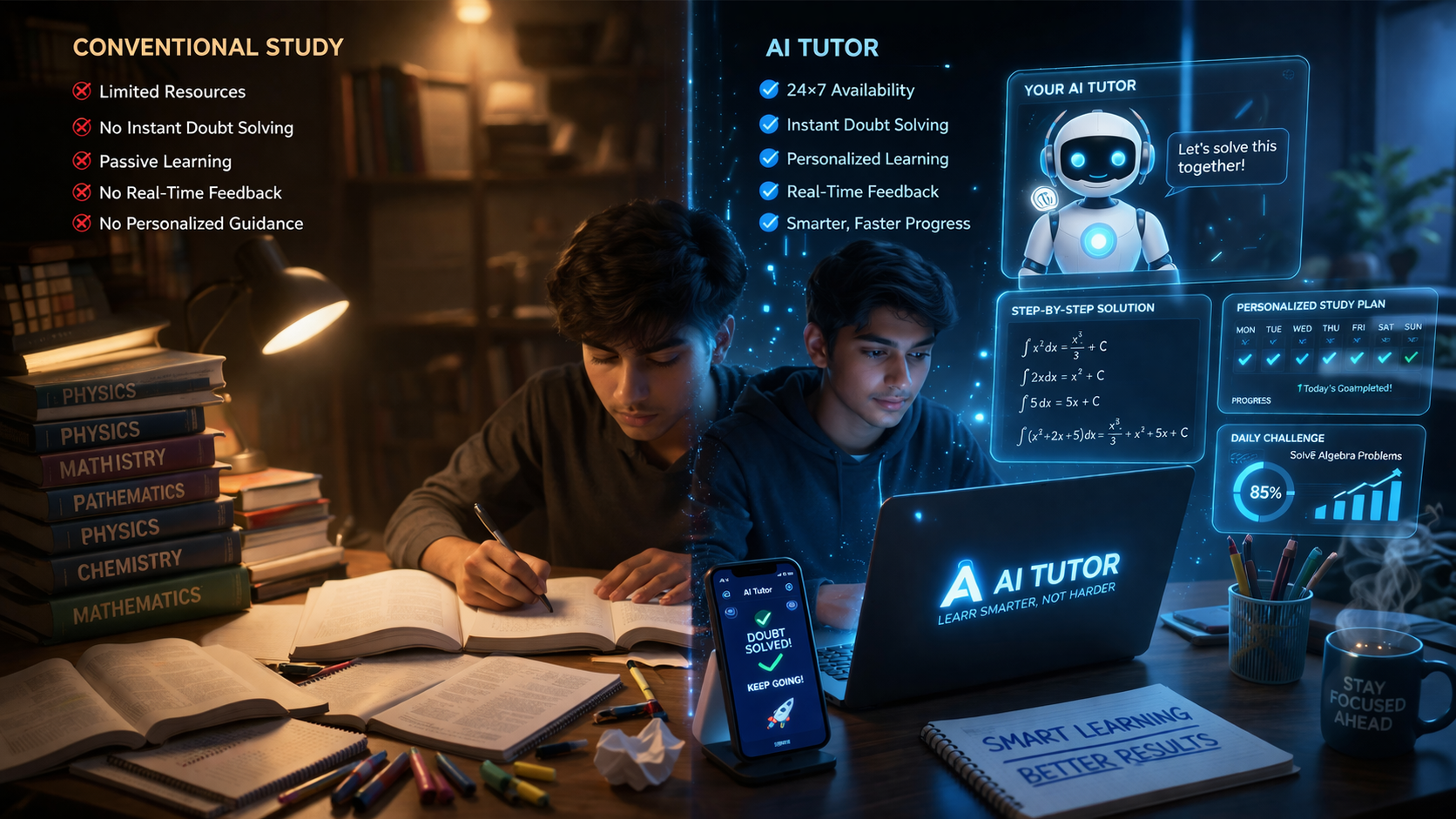
Cracking JEE requires not only hard work but also a smart strategy, clear understanding of the syllabus, consistent practice, and performance tracking. With evolving learning technologies, students now also have access to AI-powered learning systems that help them learn smarter and track progress efficiently.
This article covers:
- Complete JEE Syllabus Overview
- Subject-wise Preparation Strategy
- Smart Study Plan
- Mock Test Strategy
- Daily Practice Framework
- Mistakes to Avoid
- How AI-Based Learning Can Improve Performance
JEE Exam Structure
JEE Main
JEE Main consists of three subjects:
- Physics
- Chemistry
- Mathematics
Each subject tests conceptual understanding, problem-solving skills, and application-based knowledge.
JEE Advanced
JEE Advanced focuses more on:
- Conceptual clarity
- Multi-concept questions
- Analytical thinking
- Time management
Students must prepare deeply for fundamentals and advanced problem-solving.
Complete JEE Syllabus Overview
Physics Syllabus
Class 11 Physics
Mechanics
- Units and Dimensions
- Kinematics
- Laws of Motion
- Work, Energy, and Power
- Rotational Motion
- Gravitation
Properties of Matter
- Elasticity
- Surface Tension
- Viscosity
Thermodynamics
- Heat and Temperature
- Thermodynamics
- Kinetic Theory of Gases
Oscillation & Waves
- Oscillations
- Waves
Class 12 Physics
Electricity & Magnetism
- Electrostatics
- Current Electricity
- Magnetic Effects of Current
- Magnetism and Matter
- Electromagnetic Induction
- Alternating Current
Optics
- Ray Optics
- Wave Optics
Modern Physics
- Dual Nature of Matter
- Atoms and Nuclei
- Semiconductor Electronics
Chemistry Syllabus
Physical Chemistry
Class 11
- Mole Concept
- Atomic Structure
- Chemical Bonding
- Thermodynamics
- Equilibrium
- Redox Reactions
Class 12
- Electrochemistry
- Chemical Kinetics
- Solutions
- Surface Chemistry
Organic Chemistry
Class 11
- Basic Organic Chemistry
- Hydrocarbons
Class 12
- Haloalkanes and Haloarenes
- Alcohols, Phenols, and Ethers
- Aldehydes and Ketones
- Carboxylic Acids
- Amines
- Biomolecules
Inorganic Chemistry
- Periodic Table
- Chemical Bonding
- Coordination Compounds
- p-Block Elements
- d-Block Elements
- Metallurgy
Mathematics Syllabus
Class 11 Mathematics
- Sets and Relations
- Functions
- Trigonometry
- Complex Numbers
- Quadratic Equations
- Permutation and Combination
- Binomial Theorem
- Sequences and Series
- Straight Lines
- Circles
- Limits and Derivatives
Class 12 Mathematics
- Continuity and Differentiability
- Application of Derivatives
- Integration
- Differential Equations
- Matrices and Determinants
- Vector Algebra
- 3D Geometry
- Probability
Subject-wise Strategy
Physics Strategy
Physics requires conceptual clarity and practice.
Preparation Tips:
- Focus on understanding concepts
- Solve numerical problems daily
- Revise formulas regularly
- Practice previous year questions
Best Approach:
Concept → Formula → Example → Practice → Mock Test
Chemistry Strategy
Chemistry requires a balanced approach.
Physical Chemistry
- Practice numerical problems
- Focus on formulas
Organic Chemistry
- Understand reaction mechanisms
- Practice conversions
Inorganic Chemistry
- Revise regularly
- Use short notes
Mathematics Strategy
Mathematics requires continuous practice.
Preparation Tips:
- Solve problems daily
- Focus on weak areas
- Practice timed questions
- Revise formulas
Best Approach:
Concept → Practice → Speed → Accuracy → Mock Test
Smart Study Plan
Daily Study Plan
Morning:
- Learn new concepts
Afternoon:
- Practice questions
Evening:
- Revision
Night:
- Mock test or daily challenge
Weekly Study Plan
- Monday to Friday: Study + Practice
- Saturday: Full Mock Test
- Sunday: Revision + Weak Area Improvement
Mock Test Strategy
Mock tests play a crucial role in JEE preparation.
Benefits:
- Improve speed
- Improve accuracy
- Identify weak areas
- Improve time management
Mock Test Strategy:
- Start with topic-wise tests
- Move to subject-wise tests
- Take full-length tests
- Analyze performance
Daily Challenge Strategy
Daily problem-solving helps build consistency.
Daily Practice Benefits:
- Improve problem-solving ability
- Strengthen concepts
- Build exam confidence
Students who solve daily challenges often perform better in competitive exams.
Mistakes to Avoid
- Studying without planning
- Ignoring revision
- Not solving mock tests
- Avoiding weak topics
- Studying too many books
Smart Learning with AI
With advancements in technology, students now have access to AI-powered learning tools that help personalize preparation.
Benefits of AI-Based Learning:
- Subject-wise learning
- Performance tracking
- Weak area detection
- Adaptive mock tests
- Daily challenges
These platforms help students prepare more efficiently by focusing on their individual learning needs rather than following a one-size-fits-all approach.
Final 30-Day Strategy
Last 30 Days Plan
Week 1:
- Revise Class 11
Week 2:
- Revise Class 12
Week 3:
- Full Mock Tests
Week 4:
- Revision + Weak Topics
Final Tips to Crack JEE
- Stay consistent
- Focus on concepts
- Practice daily
- Take mock tests
- Analyze mistakes
- Stay confident
Conclusion
Cracking JEE is not just about studying hard — it is about studying smart. A structured syllabus, strong fundamentals, regular practice, and continuous performance tracking can significantly improve success chances.
Students who combine traditional learning with modern AI-based preparation tools, daily challenges, and mock tests often gain a competitive edge. Consistency, discipline, and smart learning strategies remain the key to achieving success in JEE.
Start early, stay focused, practice regularly, and keep improving every day.
Your journey to success begins today.